Papahānaumokuākea Protected Species Field Research
“Mālama i nā kaiaola ehuehu o Papahānaumokuākea” – Caring for the thriving ecosystems of Papahānaumokuākea
Papahānaumokuākea Protected Species Field Research
Home > People+Jobs > PPS Field Research

Work in the Kūpuna Islands
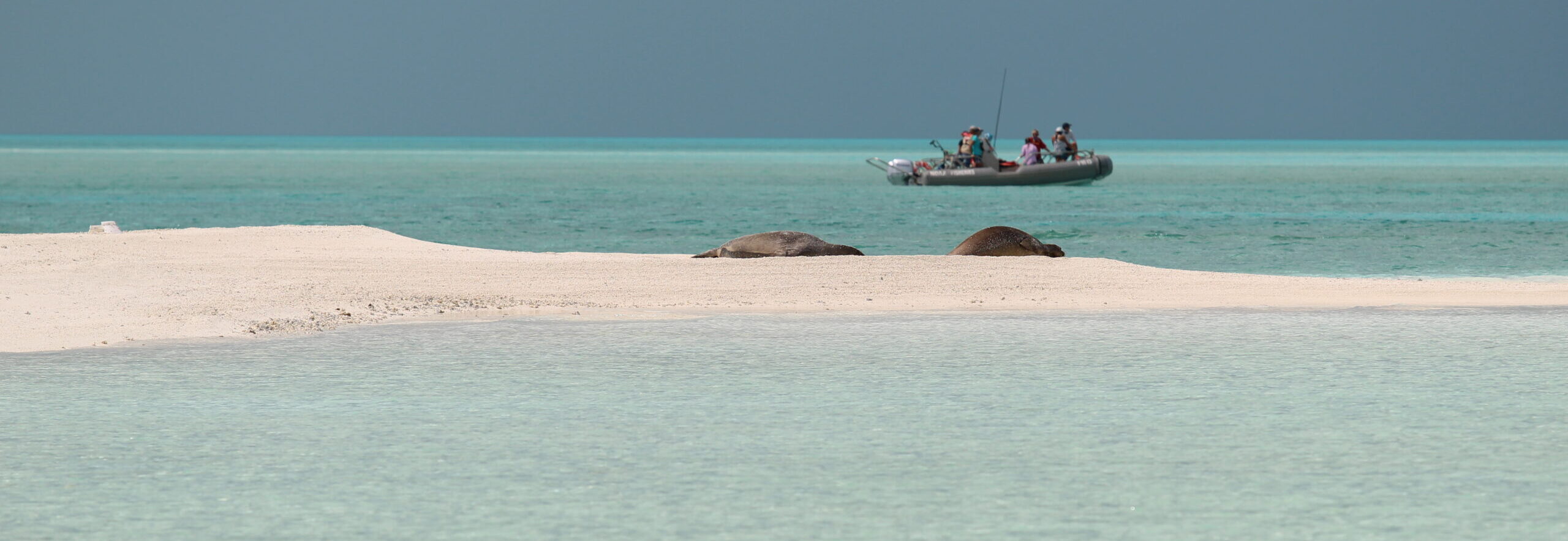
Kūpuna means elder, and it’s no surprise that Papahānaumokuākea is geologically older than the main Hawai’ian islands. Kūpuna are also the valued community members who pass ancestral knowledge and life experience to next generations. Papahānaumokuākea is a UNESCO World Heritage site that is only accessible by permit. NOAA’s Pacific Islands Fisheries Science Center partners with CIMAR to conduct research in Papahānaumokuākea. Monitoring threatened and endangered species is critical to supporting their protection and recovery. Small field teams of researchers spend 2 to 6 months each year in the Papahānaumokuākea Marine National Monument to monitor Hawaiian monk seal and green sea turtle populations at:
- Lalo (French Frigate Shoals)
- Kamole (Laysan Island)
- Kapou (Lisianski Island)
- Manawai (Pearl and Hermes Atoll)
- Kuaihelani (Midway Atoll)
- Hōlanikū (Kure Atoll)


Deployment and Life in the Field
Field camp staff begin preparations in the spring. They shop for food, test gear and equipment, and pack everything to get it ready to load on the ship. Strict biosecurity procedures must be followed to best ensure that non-native species (e.g., insects and seeds) are not introduced to the Kupuna islands. Field staff also receive training including data collection, wilderness first aid, and a NOAA boating course.
Traveling to these small islands will take several days; once there, team members will live in a camping-like environment across multiple locations. All food, water, equipment, and supplies are brought with the field teams during deployment and must last for the whole summer. Staying physically, emotionally, and mentally healthy are key to keeping up with the high-tempo, strenuous field work. Not to worry, there is also plenty of time to sit back and enjoy the unique sights, sounds and smells!


Research Objectives
Hawaiian monk seal and green sea turtle research objectives for all sites include:
- Measuring and tagging all weaned seal pups and nesting and basking turtles
- Identifying all individuals in each subpopulation
- Conducting systematic beach counts of seals and turtles
- Documenting births, deaths, serious injuries, and entanglement in marine debris
- Reuniting separated seal mother-pup pairs, disentangling, and conducting other life-saving interventions
- Conducting necropsies on dead seals and turtles
- Collecting and removing marine debris
- Participating in huli‘ia observational data
Through the service of many dedicated people over the years, we and our partners have contributed to important research and recovery efforts for the monk seal and turtle populations while protecting the overall ecosystem. We are committed to continuing this work, and invite you to apply to work on our team!
Watch this video about how a honu enthusiast from Oʻahu became a researcher and launched her scientific career!
Watch this video about how a honu enthusiast from Oʻahu became a researcher and launched her scientific career!
Watch this video about how a honu enthusiast from Oʻahu became a CIMAR researcher and launched her scientific career!


All photos taken under NMFS permits
Join Us in the FIeld
Are you interested in joining our Hawaiian monk seal or sea turtle team and studying these incredible animals? Seasonal research technicians and assistants are hired through the Research Corporation of the University of Hawai‘i in the fall for the next spring/summer field season (Search ‘Papahanaumokuakea’ on the RCUH page). You can also click Apply Now! (Search for ‘monk seal’ or ‘turtle’) For questions about an application, please use the point of contact listed in the job announcement. At other times of the year, our partners at the U.S. Fish and Wildlife Service or Department of Land and Natural Resources/Kure Atoll Conservancy may have positions open, and we work closely together so check them out too! You can also check out awesome internships and fellowships using the links below.
All photos taken under NMFS permits
Join Us in the FIeld
Are you interested in joining our Hawaiian monk seal or sea turtle team and studying these incredible animals? Seasonal research technicians and assistants are hired through the Research Corporation of the University of Hawai‘i in the fall for the next spring/summer field season (Search ‘Papahanaumokuakea’ on the RCUH page). You can also click Apply Now! (Search for ‘monk seal’ or ‘turtle’) For questions about an application, please use the point of contact listed in the job announcement. At other times of the year, our partners at the U.S. Fish and Wildlife Service or Department of Land and Natural Resources/Kure Atoll Conservancy may have positions open, and we work closely together so check them out too! You can also check out awesome internships and fellowships using the links below.
“Mālama i nā kaiaola ehuehu o Papahānaumokuākea” – Caring for the thriving ecosystems of Papahānaumokuākea
Internships and Fellowships:
- Pacific Internship Program for Exploring Sciences
- QUEST Scientific Diver Program
- Hollings Prep
- Hollings Undergraduate Scholarship
- Dr. Nancy Foster Scholarship
- PIFSC PYSO
- IN FISH
Papahānaumokuākea Opportunities
After months of care at The Marine Mammal Center’s Ke Kai Ola monk seal hospital on Hawaiʻi Island, this yearling is healthy and ready to return to the wild. Peeking out of her kennel, she seems to look toward the ocean with eager anticipation of life back home. Credit: NOAA Fisheries/Claudia Cedillo
And that’s a wrap! In early September, NOAA scientists aboard the Imua returned to Lalo to bring home the remaining field camp teams. On September 10, 2025, the vessel pulled back into Pearl Harbor—marking the close of more than four months of protected species research and conservation work across the Papahānaumokuākea Marine National Monument. Credit: NOAA Fisheries/Marylou Staman
A lone monk seal rests on Little Gin Island, Lalo. With its white sands and clear waters, the “Gins” are among the most scenic spots in Papahānaumokuākea Marine National Monument and offer seals a peaceful place to haul out and rest. Credit: NOAA Fisheries/Jonathan Schneiderman
Two monk seals rest in a tidepool along Nihoa’s rugged western shore. This area is notoriously difficult to survey, as seals are quick to flush into the water when scientists approach on foot from small boats. Uncrewed aircraft systems (drones) are transforming the way we conduct surveys here and provide better data, improve safety, and greatly reduce disturbance to the animals. Credit: NOAA Fisheries/Mark Sullivan
Sunset over the field camp on Tern Island, Lalo. The camp can hold about 10 wall tents. Each scientist has their own personal tent, while office and kitchen tents are shared spaces. With seven people living here this season, it’s one of the most populated islands in Papahānaumokuākea Marine National Monument. Credit: NOAA Fisheries/Leah Kerschner
A peek inside the “office tent” at Tern Island, Lalo. These wall tents are set up on wooden platforms each season and broken down at the end. They’re not fancy, but they provide the space and shelter needed to keep camp running. Buckets and bins hold most of the gear, so careful labeling is the key to staying organized in the field. Credit: NOAA Fisheries/Leah Kerschner
The team makes their way along the rugged shoreline of Kamole. Each day in the field brings new challenges—scorching sun, jagged terrain, and relentless swarms of brine flies that breed in the hypersaline lake at the island’s center. Credit: NOAA Fisheries/Jonathan Schneiderman
During a morning entrapment survey, the Lalo field team found an adult green sea turtle stuck behind one of Tern Island’s old seawalls after coming ashore to nest the night before. The turtle was quickly placed in a stretcher and released on the nearest beach. A curious monk seal swam over to the turtle, then slipped through a gap in the wall that the turtle couldn’t fit through. Credit: NOAA Fisheries/Andrew Glinsky
East Beach on Tern Island, Lalo is bustling with both monk seals and green sea turtles, all sharing the same stretch of sand. With a drone, researchers can document this diverse gathering from above without disturbing the animals or their habitat. It’s a clear example of how aerial surveys provide both safety for scientists and comfort for wildlife at Lalo. Credit: NOAA Fisheries/Jonathan Schneiderman

Early one morning a Hawaiian monk seal pup appeared to mistake this nesting female green sea turtle for its mother and attempted to nurse from it as it crawled along the beach. The field researchers recorded the interaction and then stayed nearby, out of sight, to ensure the pup returned to its mother safely. Credit: NOAA Fisheries/Andrew Glinsky

A scientist pilots a drone while a teammate carefully recovers it after surveying the west ledge of Nihoa Island. Hand launches and recoveries are the safest method when operating from small boats with limited deck space. Flying near 800-foot cliffs, over open water, from a rocking vessel is no easy task. The team takes a cautious, conservative approach to ensure safety for both people and equipment. Credit: NOAA Fisheries/Christy Kozama

Life in Papahānaumokuākea Marine National Monument is about as remote as it gets, especially on Kapou (Lisianski), a small island just three and a half miles around. For 16 days, three researchers from three different partner organizations called this place home, working side by side to conduct monk seal surveys and collect critical data on population dynamics. The sign they’re holding, painted by a past field camper, celebrates the seabirds, turtles, and seals that thrive on Kapou’s shores. Credit: NOAA Fisheries/Hope Ronco
Caption unavailable

Field technician scans a honu for a PIT tag on Kapou. Credit: NOAA Fisheries (Permit #22677, PMNM-2023-001)

Researchers identify seals from a distance on Kamole. Credit: NOAA Fisheries (Permit #22677, PMNM-2023-001)
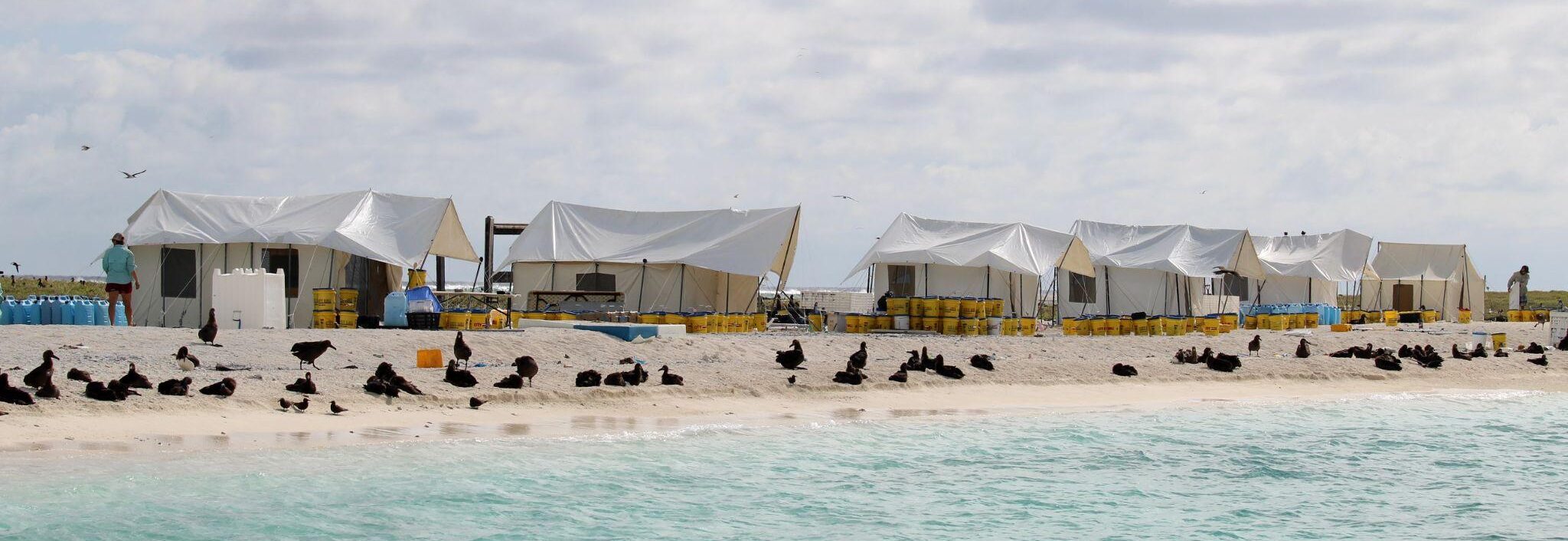
Field camp tents along the shoreline in the Papahānaumokuākea Marine National Monument. Credit: NOAA Fisheries
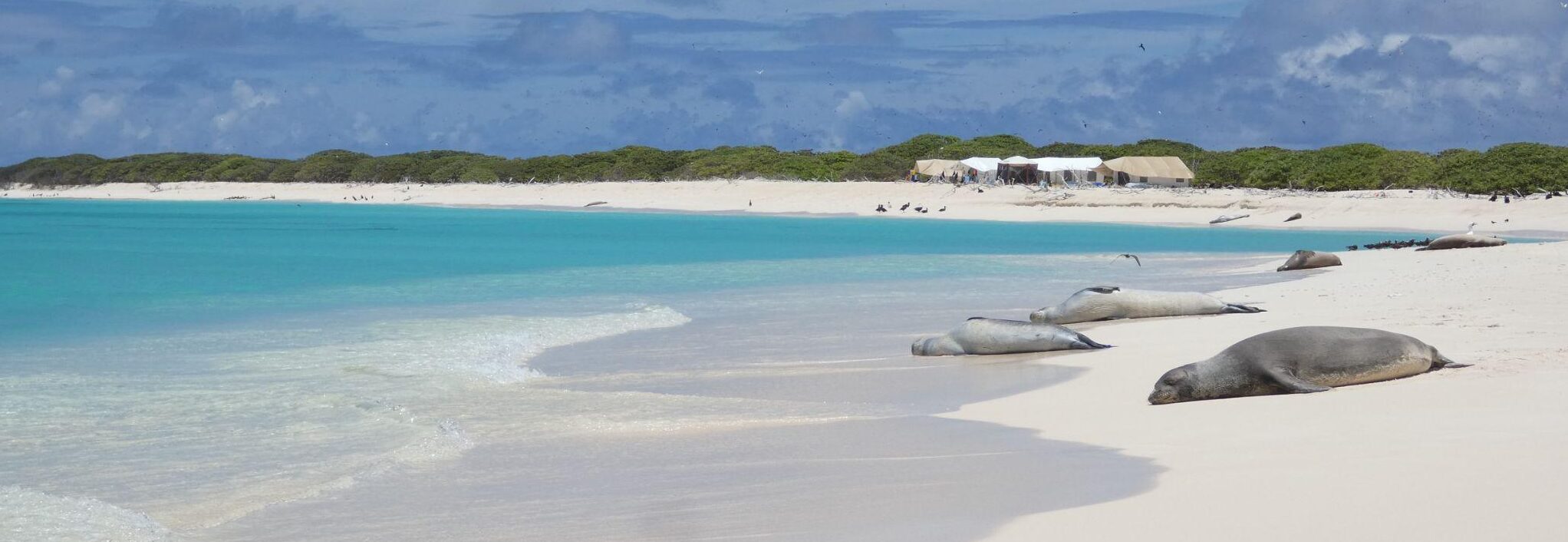
The Kapou Field camp is located on the southwest side of the island and seals regularly haul out along the south point in the foreground. The two person team at Kapou each have a personal tent and there are shared office and kitchen tents. Credit: NOAA Fisheries Permits #22677-02 and PMNM-2023-001
Caption unavailable