
-

Rain events could cause major failure of Waikīkī storm drainage by 2050
July 9, 2025
Existing sea level rise models for coastal cities often overlook the impacts of rainfall on infrastructure. Researchers at the University of Hawaiʻi at Mānoa predicted that by 2050, large rain events combined with sea level rise could cause flooding severe enough to disrupt transportation and contaminate stormwater inlets (grate or curb opening in Waikīkī’s streets that collects rainwater and directs it into the storm drainage system) across 70% of Waikīkī, due to interactions with water in the Ala Wai Canal. Their study was published in July 2025 in Scientific Reports… Read More
Photo Description: A Waikīkī storm drain nearly full during a king tide. (Photo credit: Hawaiʻi Sea Grant King Tides Project)
-
Bill to support climate research with state dollars dies amid federal cuts
April 30, 2025
Astatemeasure to fund a group of scientists collecting crucial Hawaiʻi climate data faltered on the final day of conference committee last week.
Senate Bill 657 proposed the creation of a climate data hub within the University of Hawaiʻi’s School of Ocean and Earth Science and Technology, using $2 million in state funds to support the work of 15 researchers affiliated with the Coastal Research Collaborative.
The collaborative’s research underlies many of Hawaiʻi’s key policies on sea level rise, including county shoreline setback ordinances and a recent real estate law requiring sellers to disclose whether their properties on the market are vulnerable to sea level rise and coastal erosion… Read More
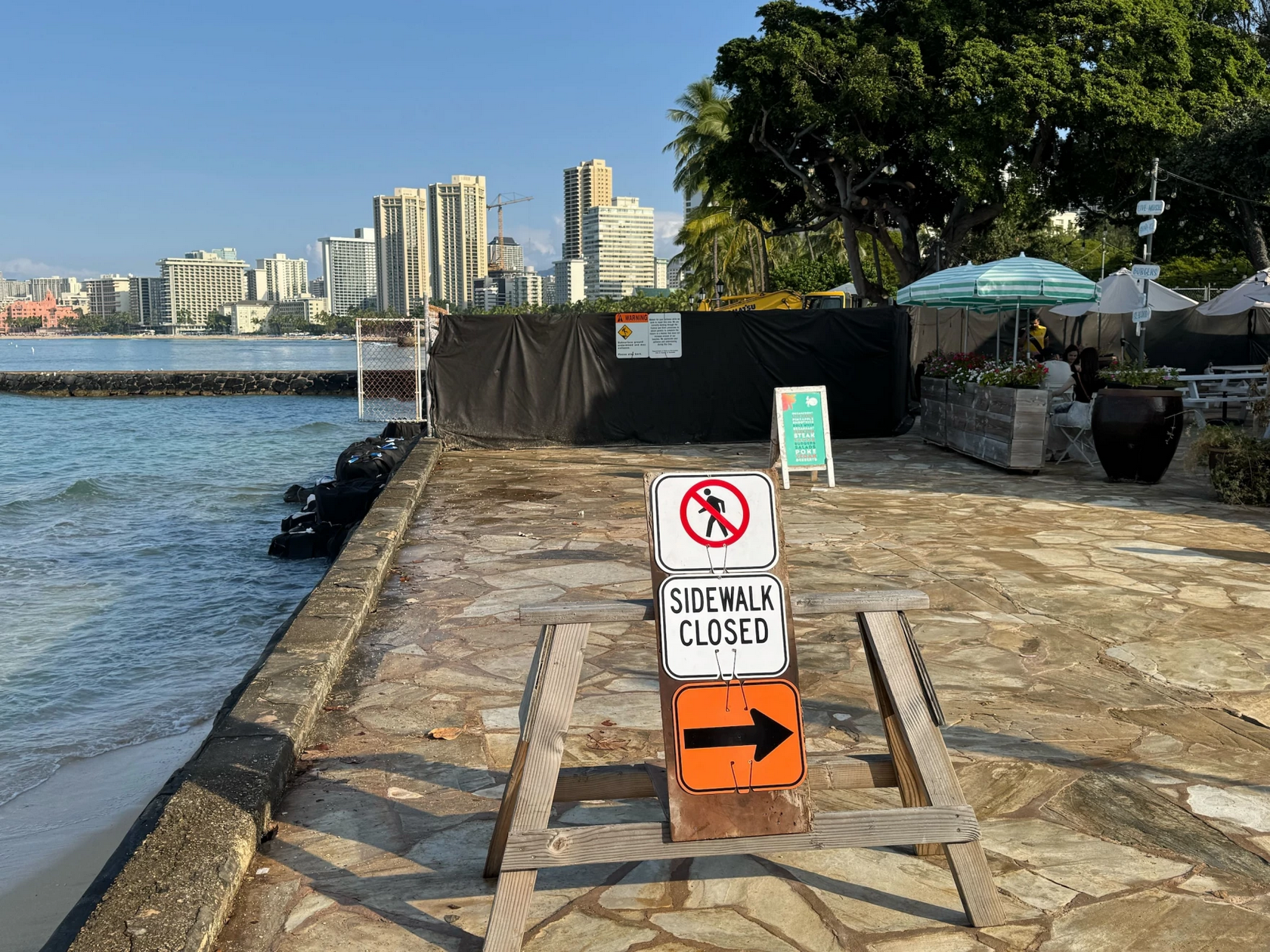
Photo Description: This waterfront walkway near the Barefoot Beach Cafe in Waikīkī is under repair after collapsing in May 2024. (Feb. 19, 2025)
Photo Credit: Catherine Cruz / HPR
-

UH researcher shares new projections of the scope and speed of coastal erosion
April 15, 2025
Sea level rise in Hawaiʻi is progressing at a faster pace than previously thought. A new set of scientific models is showing some surprising projections about the state of our beaches and shorelines.
The research comes from the lab of University of Hawaiʻi at Mānoa professor Chip Fletcher, who has been publishing models of sea level rise and beach loss since 1997.
Richelle Moskvichev, a scientific researcher in Fletcher’s lab, spoke with The Conversation about her team’s new research that was published in Scientific Reports… Read More
-

Hawaiʻi islands sinking faster in some areas; risk for flooding
March 16, 2025
Some parts of Hawaiʻi are sinking faster than others. That discovery, published recently in a study by researchers at the University of Hawaiʻi at Mānoa, also highlights that as sea level rises, the infrastructure, businesses and communities in these low-lying areas are at risk of flooding sooner than scientists anticipated, particularly in certain urban areas of Oʻahu.
“Our findings highlight that subsidence (gradual caving in or sinking of an area of land) is a major, yet often overlooked, factor in assessments of future flood exposure,” said Kyle Murray, lead author of the study and researcher with the Climate Resilience Collaborative (CRC) at the UH Mānoa School of Ocean and Earth Science and Technology (SOEST). “In rapidly subsiding areas, sea level rise impacts will be felt much sooner than previously estimated, which means that we must prepare for flooding on a shorter timeline… Read more
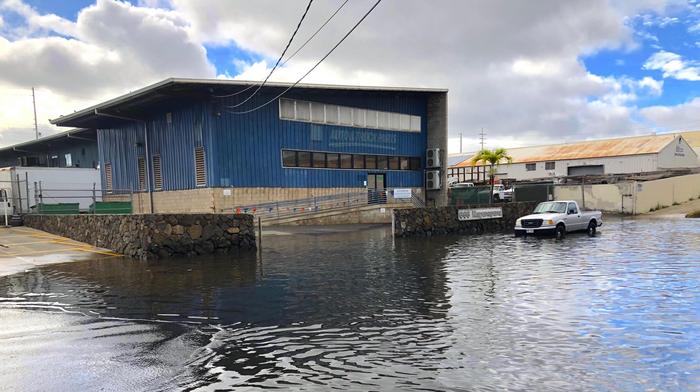
Image Caption: Flooding in the low-lying Mapunapuna industrial area on O’ahu, Hawai’i
Credit: Hawaiʻi Sea Grant King Tides Project.
-
Flooding expected sooner in Hawai’i’s sinking coastal areas
March 5, 2025
Some parts of Hawai‘i are sinking faster than others. That discovery, published recently in a study by researchers at the University of Hawai‘i (UH) at Mānoa, also highlights that as sea level rises, the infrastructure, businesses, and communities in these low-lying areas are at risk of flooding sooner than scientists anticipated, particularly in certain urban areas of O‘ahu.
“Our findings highlight that subsidence is a major, yet often overlooked, factor in assessments of future flood exposure,” said Kyle Murray, lead author of the study and researcher with the Climate Resilience Collaborative (CRC) at the UH Mānoa School of Ocean and Earth Science and Technology (SOEST). “In rapidly subsiding areas, sea level rise impacts will be felt much sooner than previously estimated, which means that we must prepare for flooding on a shorter timeline.”… Read More
Image Caption: Flooding in the low-lying Mapunapuna industrial area on O’ahu, Hawai’i
Credit: Hawaiʻi Sea Grant King Tides Project.
-
Waikīkī businesses, residents face underground flooding due to sea level rise
February 21, 2025
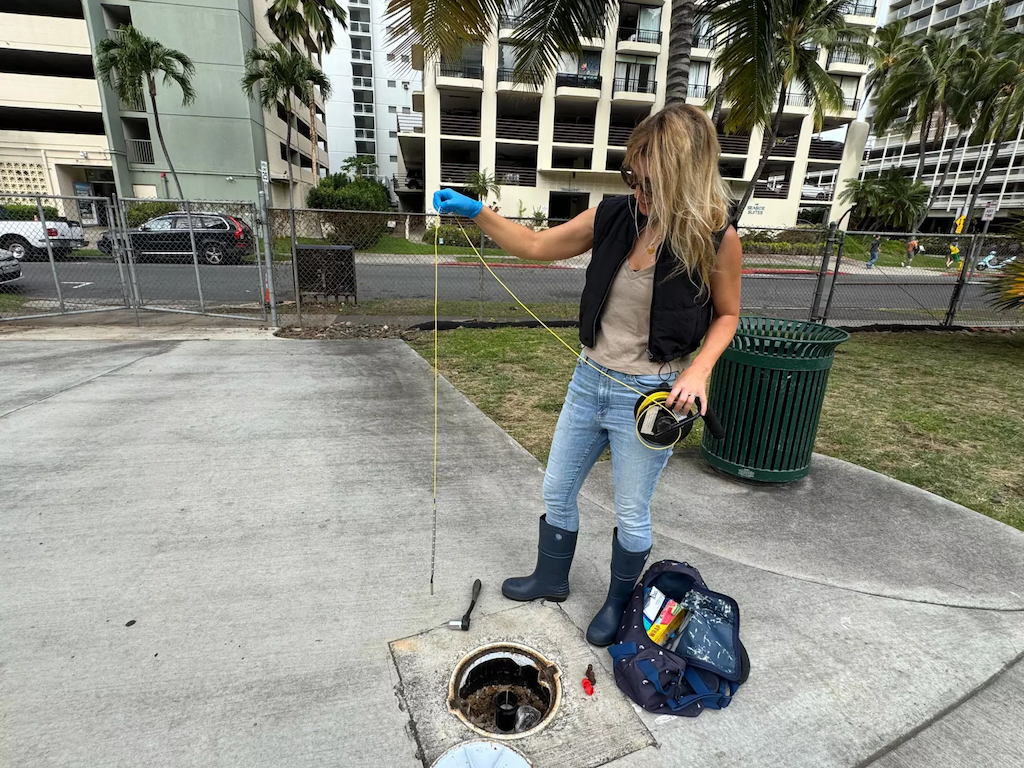
Shellie Habel is a hydrologist and geologist with the University of Hawaiʻi’s Climate Resilience Collaborative. Partnering with the Honolulu Board of Water Supply, Habel monitors groundwater wells in Waikīkī to study the hidden threat of rising sea levels.
HPR connected with her last week as she fished out specialized equipment from the Ala Wai Canal to study flood inundation. She said that her research over the years has tracked high levels of fecal bacteria correlating to high visitor counts in Waikīkī hotels, which makes you wonder how it’s getting in the canal… Read More
-

Sea Level Research in Rapa Nui
February 2, 2025
Check out Noah Paoa’s Research in Rapa Nui!
Video Created by Moana Nui – @MoanaNuiFilms
-
Human converging crises: climate change, ecological destruction, disease, pollution, and socioeconomic inequality
December 11, 2024
The interconnected global crises—climate change, water scarcity, food insecurity, and inequality—are intensifying due to unsustainable, profit-driven economic systems. Rising temperatures and CO2 levels threaten humanity, while freshwater depletion jeopardizes food security and public health. Vulnerable populations bear the brunt of these crises, highlighting the need for a cultural shift toward sustainability and equity. Addressing these challenges requires a holistic approach that prioritizes social justice, sustainable resource management, and urgent action to limit global warming to 1.5°C… Read More
-
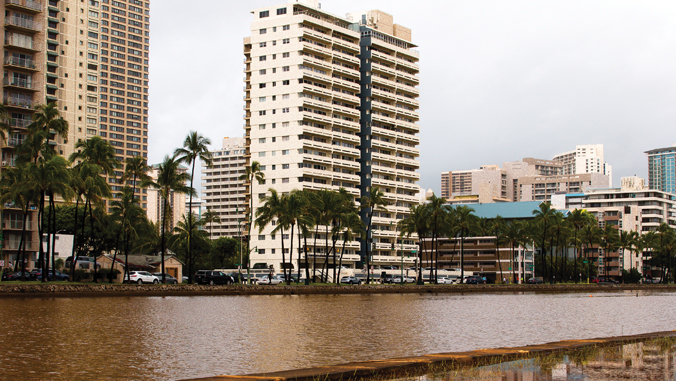
Waikīkī adaptation project earns national recognition
January 16, 2025
A University of Hawaiʻi at Mānoa-led project addressing adaptation for Waikīkī has received national recognition for its architectural innovation in pushing the boundaries of design. The project earned a design award from the Society of American Registered Architects (SARA) in New York City in October 2024.“This national recognition from SARA underscores the widespread interest in using the latest science to inform the design of resilient buildings and communities that can change over time,” said Wendy Meguro, director of the School of Architecture’s Environmental Research and Design Laboratory and the Hawaiʻi Sea Grant Center for Smart Building and Community Design… Read More
-
The Influence of sea-level rise on coastal groundwater and resulting impacts on municipal infrastructure
December 11, 2024
Sea-level rise is causing groundwater levels to rise, leading to critical challenges like saltwater intrusion, surface flooding, and damage to municipal infrastructure. Honolulu, a key case study, highlights how urban areas, especially those built on wetlands, face risks such as corrosive groundwater affecting infrastructure and emerging groundwater causing flooding. These issues are global, affecting cities like San Francisco and New York. Research focuses on modeling groundwater emergence and collecting data to inform urban planning and policies, aiming to mitigate the impacts and help communities adapt to climate change… Read More
-

Sea Level Rise Is A Science Issue, Not Just An Environmental Concern
December 23, 2024
Hawai‘i faces an undeniable and accelerating threat from climate change. Sea level rise, tropical cyclone intensification, prolonged droughts, “rain bombs,” and marine heat waves are no longer distant possibilities — they are realities reshaping our islands. Yet, some still dismiss the integration of sea level rise into government policies and regulations as merely an “environmental issue.” This perspective is not only misguided but dangerous. Sea level rise is a science issue — and public policies must be grounded in science if Hawai‘i is to protect its people, economy, and future… Read More
-
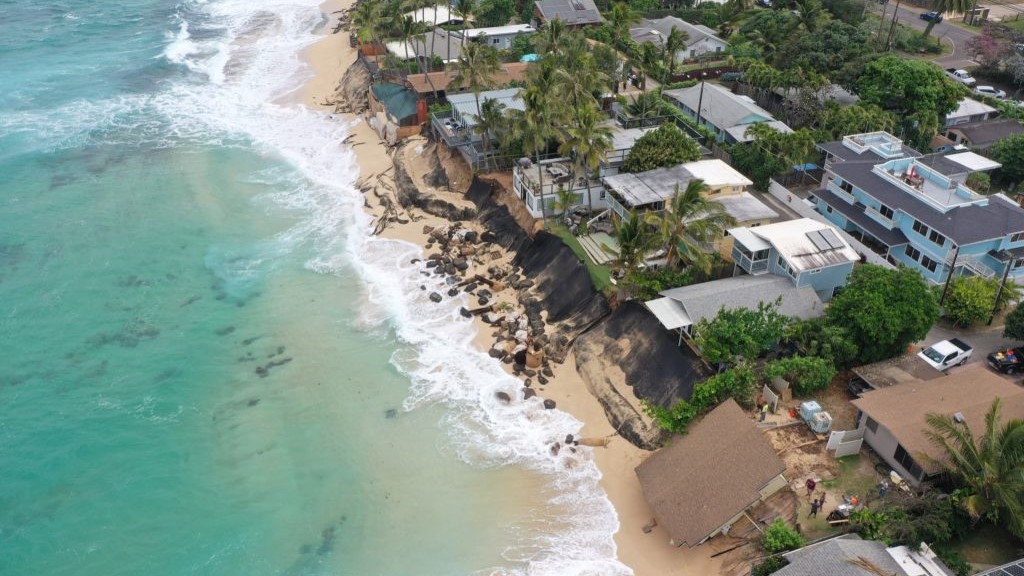
Column: Hawaii’s climate call: Lead on adaptation, mitigation
November 10, 2024
As we pass the halfway point of the 2020s, the climate crisis is escalating at a pace that defies our preparedness. Global greenhouse gas emissions remain dangerously high, and this year set records for both heat and atmospheric carbon dioxide levels, with CO2 concentration rising by an unprecedented 3.4 parts per million, an 86% increase over the previous year’s growth rate, marking the highest rise in recorded history. Last year, natural carbon sinks like forests and soils absorbed nearly no carbon, and essential climate system components — including ice sheets, ocean circulation and tropical forests — are approaching irreversible tipping points. The world is currently on track for a temperature increase of 2.6 to 3.1 C by century’s end, a rise that would make large areas of our planet unlivable… Read More